

Angel Investing Explained: Risks, Rewards, and Strategies
A Comprehensive Guide to Startup Investing, Risk Management, and Building Your Early-Stage Investment Portfolio
You are stepping into the void. You are betting on a person, a dream, and a fledgling idea that has yet to prove it can survive the harsh realities of the market.
It is arguably the most romanticized form of finance. We hear the lore: the early check written into Google, the seed money that transformed a garage startup into a unicorn. But behind the glamour lies a gritty, complex, and statistically risky asset class that requires far more than just a checkbook. It requires a specific mindset, a high tolerance for chaos, and, increasingly, a strong network. Welcome to the world of Angel Investing.
Key SEO Takeaway
Angel investing represents high-risk, high-reward opportunities in early-stage startups. Successful angel investors combine financial analysis with founder evaluation and sector expertise to build diversified portfolios in this exciting asset class.
Defining the Angel: The Fuel of the Startup Ecosystem
In the financial hierarchy, Angel Investing occupies a unique and critical niche. It sits in the precarious gap between the “Friends, Family, and Fools” round (where a startup raises money from people who love them) and the institutional Venture Capital (VC) round.
Unlike a bank, which lends money based on collateral and credit scores, or a VC, which invests other people’s money based on strict fund mandates, an angel invests their own capital.
This distinction changes the psychology of the deal. Because it is their own money on the line, angels often invest based on a more personal set of criteria. They are betting on the “jockey” (the founder) as much as the “horse” (the product). They fill a vacuum in the market where traditional financing fears to tread. Banks won’t lend to a company with no assets, and VCs won’t look at a company that hasn’t proven product-market fit yet. The angel investor steps in here, providing the essential runway that allows a startup to build its prototype, get its first customers, and survive long enough to raise that big Series A round. Without angels, the innovation pipeline would simply dry up.
The Many Faces of the Angel: Types of Angel Investors
Just as no two startups are alike, the world of angel investing is not a monolith. It is a diverse ecosystem composed of different archetypes, each bringing a different flavor of capital to the table.
The Check-Writing Angel
This is the traditional image. A wealthy individual, often a successful entrepreneur who exited a previous business, who writes checks ranging from $25,000 to $100,000. They invest in familiar sectors and provide primarily financial capital.
The Super Angel
A newer breed operating like a mini-VC firm. They make 30-50 investments per year with high frequency and volume, often leading rounds or taking board seats. They bridge the gap between individual angels and institutional funds.
The Operator Angel
Current or former executives from major tech companies who invest alongside their careers. They offer invaluable operational expertise, mentorship, and network connections that can be more valuable than capital alone.
Additional Angel Investor Archetypes
The Strategic Angel: Corporate executives who invest to gain early access to innovative technologies that could benefit their primary employer or industry.
The Micro Angel: Part of the emerging trend of smaller-scale investors participating through equity crowdfunding platforms, democratizing access to early-stage investing.
The Syndicate Lead: Investors who organize groups of smaller angels to pool capital and expertise, enabling participation in larger rounds with professional due diligence.
Critical Risk Assessment
Angel investing carries significant risks: 90% of startups fail, investments are illiquid (5-10 year horizons), and dilution occurs in subsequent funding rounds. Successful angels mitigate these risks through portfolio diversification (15-25 companies), thorough due diligence, and active post-investment engagement.
The Angel Investment Process: From Sourcing to Exit
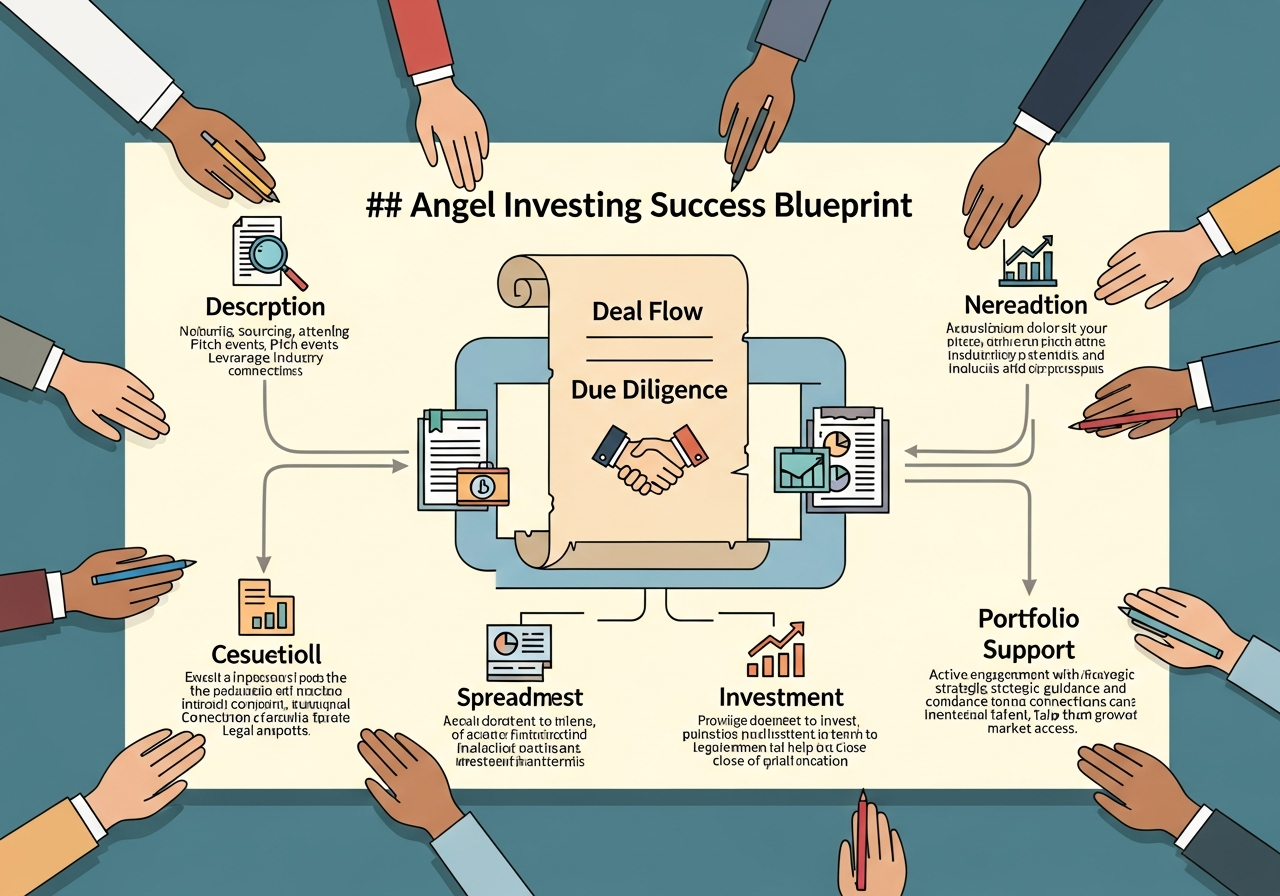
Successful angel investing follows a structured process:
- Deal Sourcing: Finding opportunities through networks, angel groups, demo days, and referral systems
- Screening: Evaluating hundreds of opportunities to identify the 1-2% worth serious consideration
- Due Diligence: Investigating the team, market, technology, financials, and legal structure
- Term Sheet Negotiation: Establishing valuation, equity stake, rights, and protections
- Post-Investment Engagement: Providing mentorship, connections, and strategic guidance
- Exit Planning: Preparing for acquisition, IPO, or secondary sale opportunities
Angel Investing Frequently Asked Questions
Traditional angel investments typically range from $25,000 to $100,000 per deal. However, through equity crowdfunding platforms and angel syndicates, entry points can be as low as $1,000-$5,000. The key is having sufficient capital to build a diversified portfolio of at least 15-20 companies, requiring approximately $250,000-$500,000 in total investable capital dedicated to this asset class.
Angel investors generate returns primarily through exit events: acquisitions (where a larger company buys the startup), IPOs (initial public offerings), or secondary sales (selling shares to later investors). Successful exits typically occur 5-10 years after the initial investment. The portfolio approach is crucial—while most investments fail, a single “home run” (returning 50-100x) can make the entire portfolio profitable.
Industry data suggests 70-90% of angel-backed startups fail to return capital. Approximately 50% fail completely (return 0x), 30% return 1-3x, 15% return 3-10x, and 5% return 10x or more. This power law distribution means angel investing requires embracing high failure rates while pursuing those rare, outsized returns that compensate for losses across the portfolio.
In the United States, SEC regulations generally require angel investors to be “accredited investors”—individuals with either $1 million net worth (excluding primary residence) or $200,000 annual income ($300,000 joint) for the last two years. However, equity crowdfunding platforms under Regulation CF allow non-accredited investors to participate with investment limits based on income and net worth.
Successful evaluation focuses on three pillars: Team (experience, commitment, domain expertise), Market (size, growth, defensibility), and Product/Technology (uniqueness, scalability, IP protection). Key metrics include Monthly Recurring Revenue (MRR) growth rate, Customer Acquisition Cost (CAC), Lifetime Value (LTV), burn rate, and traction indicators.
In many jurisdictions, angel investors can benefit from tax incentives like the Qualified Small Business Stock (QSBS) exclusion in the US (potentially 100% tax-free gains), R&D tax credits, and loss write-offs. The UK’s Seed Enterprise Investment Scheme (SEIS) offers 50% income tax relief.
Passive angel investing (writing checks only) requires minimal time beyond initial due diligence. Active angel investing (providing mentorship, board service, connections) can require 5-20 hours per month per portfolio company. Most serious angels spend significant time sourcing deals and conducting due diligence.
Angel groups provide deal flow, shared due diligence, learning opportunities, and portfolio diversification. They’re ideal for beginners. Individual investing offers more control, flexibility, and potentially stronger founder relationships but requires more expertise and time.
Key documents include: Term Sheet (non-binding investment terms), Stock Purchase Agreement (legal purchase contract), Investors’ Rights Agreement (information rights, registration rights), Right of First Refusal/Co-Sale Agreement (transfer restrictions), and Voting Agreement (board composition, major decisions).
Angel investments are illiquid with typical hold periods of 5-10 years. Early exits (under 3 years) are rare and often indicate either exceptional success or premature acquisition. The J-curve effect is common—portfolios show negative returns for 3-5 years before successful companies mature and create value.
Building Your Angel Investment Strategy
A successful angel investment approach requires:
- Portfolio Mindset: Planning for 15-25 investments over 2-3 years
- Sector Specialization: Focusing on industries where you have expertise or networks
- Staged Commitment: Starting with smaller investments in syndicates before leading deals
- Active vs. Passive: Determining your desired level of involvement with portfolio companies
- Continuous Learning: Staying current with market trends, legal changes, and investment best practices
Ready to Start Your Angel Investing Journey?
Join our network of experienced investors, access vetted opportunities, and learn from successful angels who have built profitable early-stage portfolios.
Explore Angel Investment Opportunities
📚 Helpful Resources for Angel Investors
Continue your learning journey with these trusted resources categorized by topic:
- Definitions & Education: Angel Investor Definition & Guide – Investopedia
- Regulatory & Compliance: Capital Raising & Crowdfunding Rules – U.S. Securities and Exchange Commission
- Research & Data: The Returns to Angel Investors – National Bureau of Economic Research
- Association: Angel Capital Association Resources – ACA
- Entrepreneurship: Entrepreneurial Research & Trends – Kauffman Foundation
These external resources provide additional context, regulatory information, and data for angel investors.


0 thoughts on “Angel Investing Guide How to Invest in Startups Successfully”